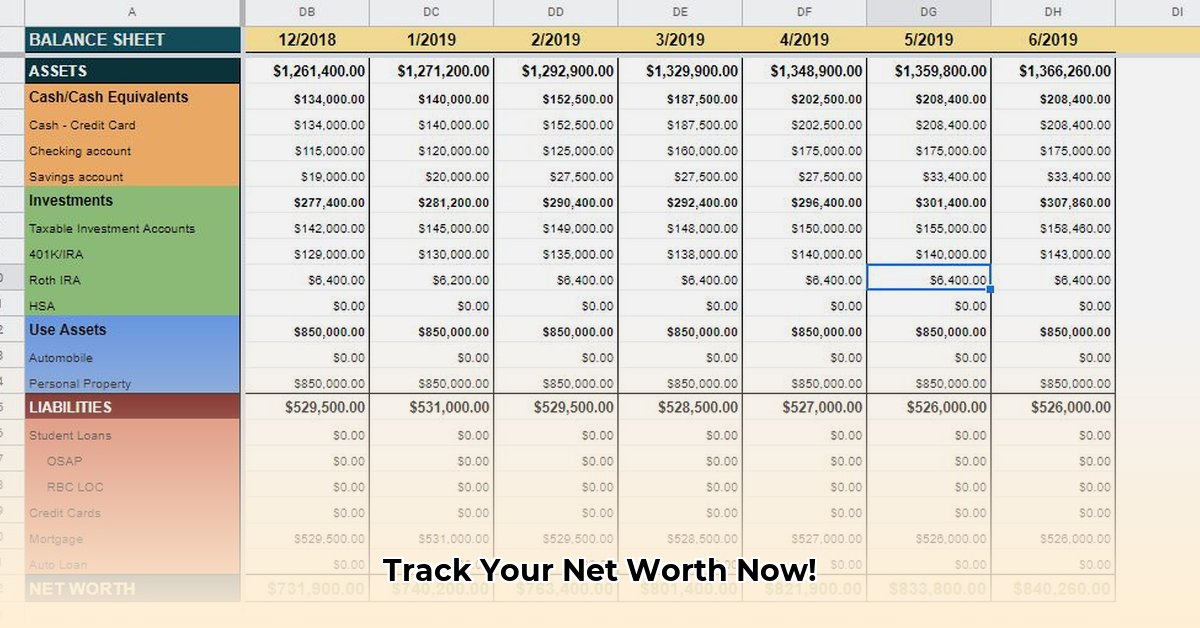
Ready to gain a clearer understanding of your financial situation? A net worth statement, easily created using a free Excel template, provides a powerful snapshot of your financial health. This comprehensive guide will walk you through creating and using a net worth statement, helping you take control of your finances and make informed decisions. For more detailed information, check out this helpful net worth guide.
What is a Net Worth Statement?
A net worth statement is a simple yet powerful tool that summarizes your overall financial position at a specific point in time. It's the difference between your assets (what you own) and your liabilities (what you owe). The formula is straightforward: Assets - Liabilities = Net Worth.
Assets include items like cash, savings accounts, investments (stocks, bonds, retirement accounts), real estate, vehicles, and valuable personal property. Liabilities encompass debts such as credit card balances, mortgages, student loans, car loans, and other outstanding obligations.
For example: If you have $10,000 in savings and a car worth $5,000 (total assets: $15,000), but owe $2,000 on a credit card and $10,000 on a student loan (total liabilities: $12,000), your net worth is $3,000 ($15,000 - $12,000 = $3,000).
Why Use a Net Worth Statement?
Creating and regularly monitoring your net worth statement offers several significant advantages:
Track Progress Toward Financial Goals: Are you saving enough for a down payment, retirement, or other goals? A net worth statement provides clear visibility into your progress. Seeing your net worth increase is motivating and helps keep you accountable.
Improve Loan Applications: Lenders often review net worth statements to assess an applicant's financial stability. A well-presented statement demonstrates your financial understanding and responsibility, enhancing your chances of loan approval.
Set Realistic Financial Goals: Your net worth provides a baseline for setting realistic financial goals. Knowing your current financial standing helps define achievable short-term and long-term targets.
Identify Areas for Improvement: A net worth statement may highlight areas needing attention. Perhaps your debt is too high relative to your assets, or your savings are insufficient for your goals. This awareness empowers you to take corrective action.
How to Create a Net Worth Statement in Excel: A Step-by-Step Guide
Follow these steps to create your personal net worth statement using a free Excel template:
Download a Template: Numerous free net worth statement templates are available online. Search for "free net worth statement Excel template" to find one that suits your needs.
Categorize Your Assets: List all your assets, categorizing them logically for clarity. Include everything from checking and savings accounts to investments (with current market values), real estate, vehicles, and valuable personal possessions. Accuracy is crucial.
Detail Your Liabilities: Similarly, list all outstanding debts, including credit card balances, mortgages, student loans, and other liabilities. Record the precise amount owed for each debt.
Calculate Totals: Use Excel's SUM function to calculate the total value of your assets and liabilities separately.
Determine Your Net Worth: Subtract your total liabilities from your total assets. The result is your net worth. Remember, this is a snapshot in time.
Regularly Update: Update your net worth statement at least quarterly, or more frequently if your financial situation changes significantly (e.g., a major purchase or debt repayment).
Valuing Your Assets: Addressing Potential Challenges
Accurately valuing your assets is critical for a precise net worth calculation. Liquid assets like cash and publicly traded stocks are easily valued. However, illiquid assets (real estate, collectibles, privately held businesses) require more careful consideration. For these, you might need a professional appraisal or consult market data to determine a fair value. Using conservative estimates when unsure is always a best practice.
Interpreting Your Net Worth Statement
Your net worth statement provides more than just a single number; it's a valuable tool for financial self-assessment. A positive net worth means your assets exceed your liabilities, while a negative net worth indicates the opposite. The key isn't the number itself, but the trend - are you consistently reducing debt and increasing your assets? That signifies positive financial health.
Maintaining Your Net Worth Statement: A Habit for Success
Regularly updating your net worth statement (at least quarterly) is crucial for continuous financial monitoring. This enables you to track progress, identify areas needing improvement, and adjust your strategy accordingly. Consistent tracking empowers you to make well-informed financial decisions. Remember, financial success is a journey, not a destination, and your net worth statement is an invaluable tool along the way.